

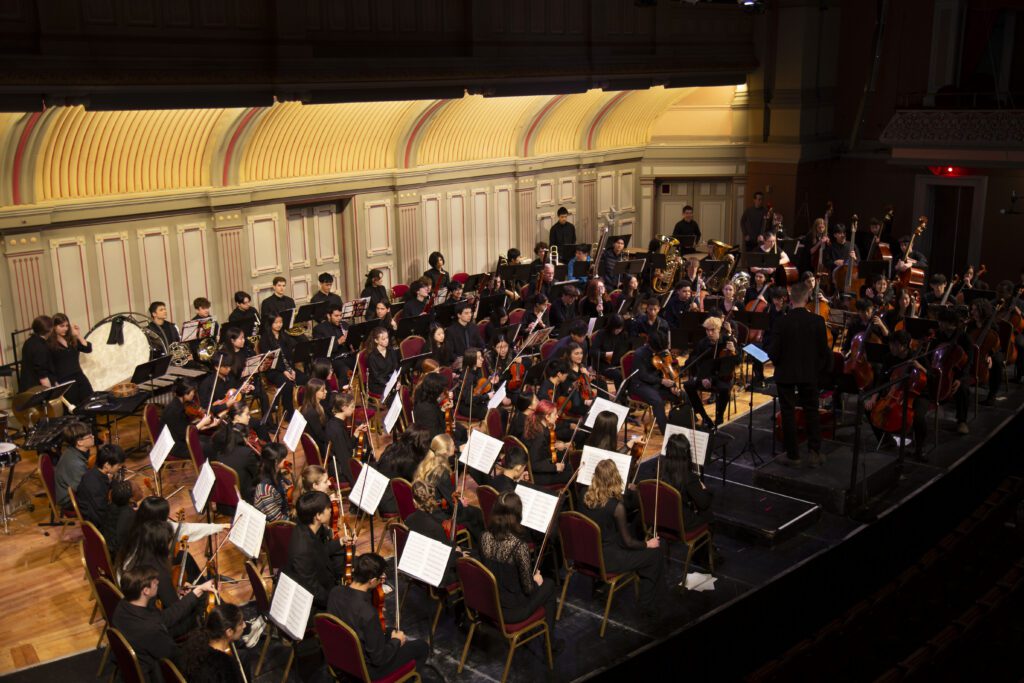
The Symphony Orchestra concert is shaped less as a display of contrasts than as a
continuum: music that unfolds, evolves, and stays in motion. It marks the third year of
ESYO’s collaboration with the RPI Orchestra and its conductor, Dr. Robert Whalen,
bringing together young musicians from across the region in a shared musical project. It
has connected young musicians to learn and share the language of music and life with
one another.
The program opens with Bedřich Smetana’s The Moldau, from Má vlast, conducted by
Dr. Whalen. At first, we listen to a river, two small springs joining into a single current.
But as the music unfolds, the perspective shifts: we begin to feel inside that flow. The
river moves through scenes that resemble stages of a life; energy and expansion,
dance and community, quieter reflection, and moments of turbulence, without ever
coming to rest.
At the center of the program is ESYO’s 2026 Lois Lyman Concerto Competition
Symphony Award winner, Ben Posner, the first tuba player in the competition’s history
to receive this honor. Posner will perform Richard Strauss’s First Horn Concerto,
reimagined on the tuba, bringing a new voice to a work written in the composer’s late
teens. Strauss’s concerto sits naturally between Smetana and Mahler. Its opening call
seems to emerge from the same natural world as The Moldau, while its long, arching
lines and moments of brilliance point toward a more personal, inward expression. In
Posner’s performance, the tuba, often heard as a foundation, steps forward as a lyrical
and agile solo voice, reshaping expectations and drawing attention to the act of
emergence itself.
The concert culminates in Gustav Mahler’s Symphony No. 1, conducted, like the
Strauss, by ESYO Music Director Etienne Abelin, a work that turns a sense of
movement inward. Written in his twenties, the symphony unfolds like a mind in motion
which is full of contrasts, sudden shifts, and unexpected juxtapositions. Mahler allows
beauty and unease to coexist: tender, song-like passages give way to something more
distant or unsettled; a familiar tune appears in an unfamiliar, shadowed form; a rustic
dance interrupts the symphonic flow. Rather than resolving these tensions, Mahler lets
them stand. His music reflects a world, and an inner life, understood in increasingly
complex ways. The result is not a single, unified statement, but a landscape of
experiences held together in one continuous arc, rising gradually toward a hard-won,
radiant conclusion.
The Fire Within is, at its core, a portrait of growth in real time—music that mirrors the
experience of the young musicians performing it: forward-moving, searching, and alive
to contradiction.